What We Do
Guidance, community and practical support
We publish plain English guidance for people joining, serving and leaving service, run a peer community where questions can be asked without judgement, share lived experience from across the Defence community, and signpost people to established support. The case for that work is set out below.
Why Dyslexia Awareness Matters in Defence
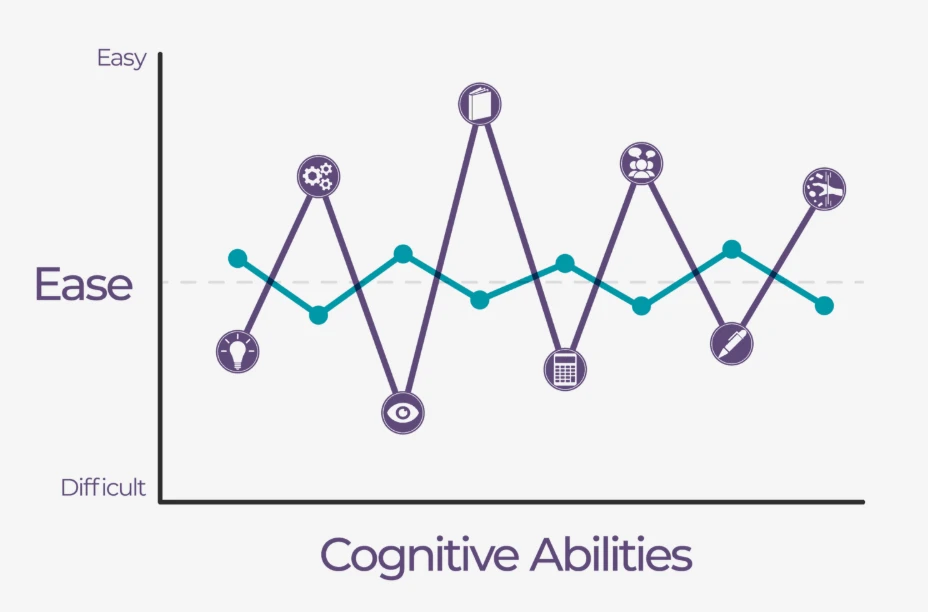
The Dyslexic "Spiky Profile"
It is estimated that 10% of the population has dyslexia with up to 20% showing indicators of dyslexia. This is a Company in a Battalion, 135 people on the Queen Elizabeth class ship, just under 7000 aviators in the RAF and 2500 people in Defence Equipment & Support.
All these people will have 'spikey profiles'. This means performance in different areas is significantly weaker or stronger than the average.
This Isn't Theory. It's Real Experience.
These experiences are not theoretical. Read real stories from people across the Defence community who have lived with dyslexia throughout their careers.
For many years, people with dyslexia have been assessed, judged, and filtered based primarily on the lowest points of that profile. Recruitment processes, exams, training systems, and workplace assessments frequently focus on areas where dyslexic individuals may struggle — such as processing speed, written accuracy, or certain forms of working memory.
What is often overlooked is the top half of the spiky profile. Dyslexic individuals frequently demonstrate strong capabilities in analytical thinking, problem solving, spatial reasoning, pattern recognition, creativity, and strategic thinking.
The result is that organisations can unintentionally screen out or undervalue people who may possess exceptional strengths. This is shown with the quote below:
Research on neurodiverse UK military veterans points to the same pattern — recruitment and workplace systems are often designed around neurotypical expectations, which can quietly disadvantage people who think differently (Allen et al., 2023).
"Everybody is a genius. But if you judge a fish by its ability to climb a tree, it will live its whole life believing that it is stupid."
The goal is not to ignore the lower points. Those areas simply require practical support — and in many cases that support is straightforward: clear written instructions, assistive technology, flexible communication formats, or adjusted workflows.
These small adjustments allow the strengths at the top of the profile to be fully realised.
When organisations recognise both sides of the spiky profile — supporting the weaker areas while enabling the stronger ones — they unlock individuals who can contribute enormous value.
This is the core idea behind Dyslexia in Defence.
The network exists to help defence and security organisations stop focusing solely on the bottom of the spiky profile and instead create environments where dyslexic individuals can succeed, contribute, and thrive.
Dyslexic Strengths
Who We Support
Pre service
Candidates exploring defence and security careers.
Serving
Active personnel across military and civilian roles.
Veterans
Those transitioning to civilian life.
Industry
Defence and security contractors and partners.
Families
Dependants navigating support.
What to do next
Pick the path that fits where you are right now.